San Antonio Connected Vehicle PlugFest a Success
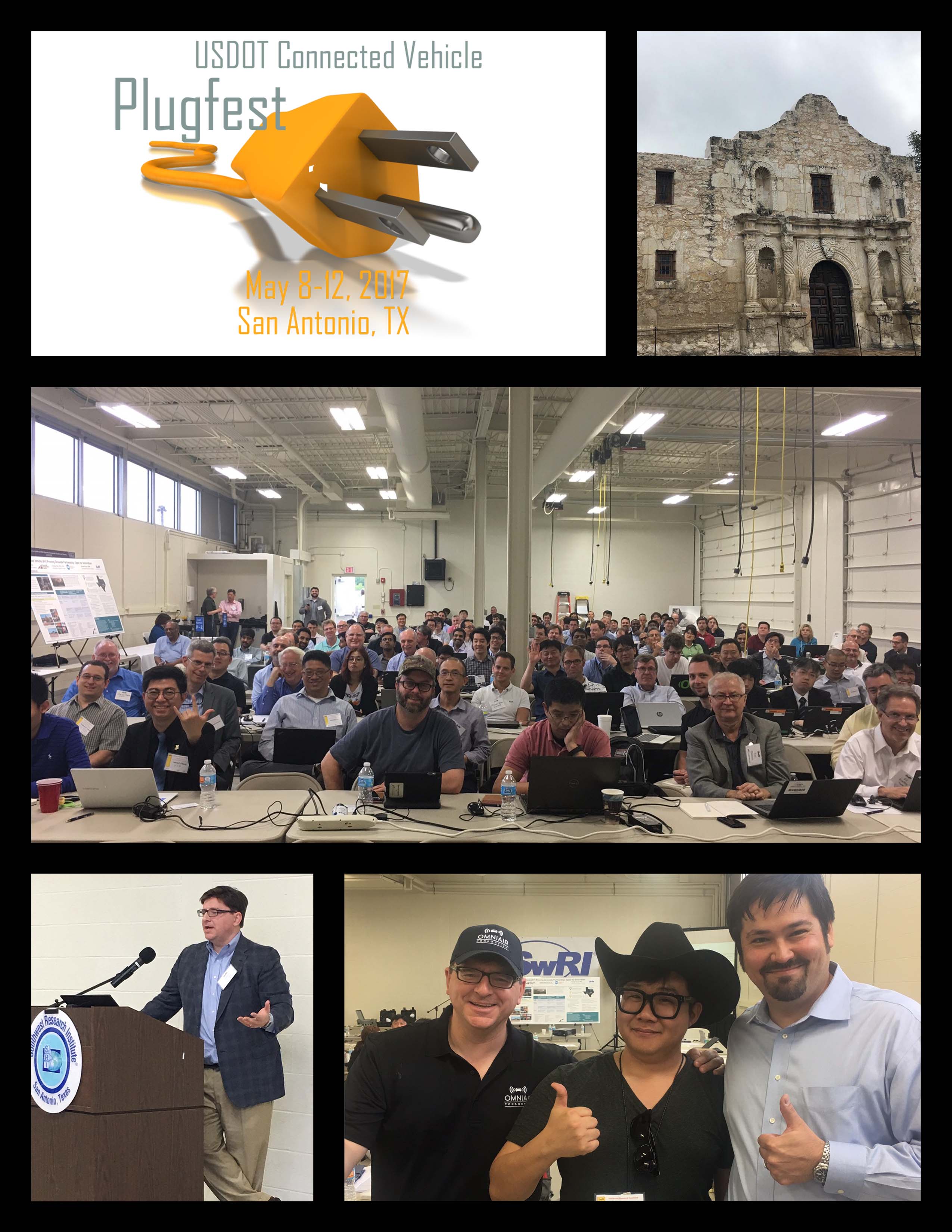
The recent U.S. Department of Transportation Connected Vehicle PlugFest was a resounding success. The May 8-12 event, hosted at the Southwest Research Institute’s campus in San Antonio, TX, focused on testing and certifying DSRC-based V2X devices.

Over 200 attendees, representing 70 organizations, from 17 countries participated in the week-long event, that focused on testing of DSRC devices. Device manufacturers participated in bench testing, interoperability testing, and field testing. View PlugFest images here!

Jeffrey Ballone of the Department of Transportation’s Volpe Center, kicked off the event with a vision for how Connected Vehicle technologies can dramatically reduce vehicle fatalities. Southwest Research Institute’s Mike Brown and Purser Sturgeon discussed the status of testing requirements and Dmitri Khijniak of 7Layers talked about DSRC device certification, including OmniAir’s planned certification program and Bill Lattin of Integrity Security Services discussed the commercial perspective regarding SCMS.

“Connected Vehicle technology is poised to hit the market,” said, Jason Conley, Executive Director at Omniair. “The strong participation in this Plugfest by automotive OEMs, tier 1 suppliers, device manufacturers, and software developers from around the world is a testament to readiness of DSRC-based V2X technology for deployment–now.”

OmniAir is preparing to launch its Connected Vehicle Certification program later this summer, and to host a Plugfest in the San Francisco Bay Area in October.

OmniAir members participating in the Plugfest: 

Future OmniAir members participating in the PlugFest:  

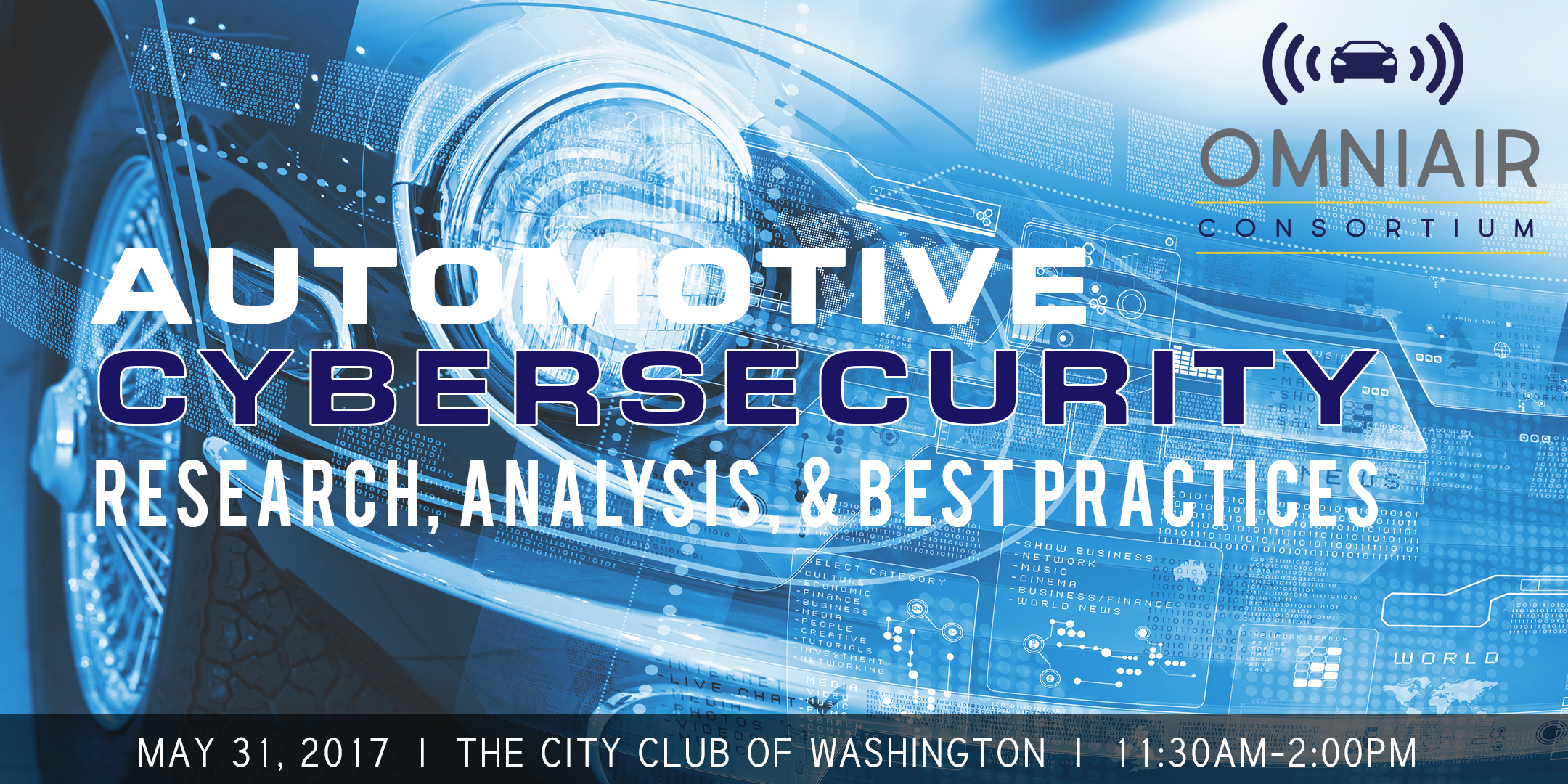
CYMOTIVE Sponsors OmniAir Automotive Cybersecurity Forum   

OmniAir Consortium Inc., the leading industry association promoting interoperability and certification for connected vehicles, ITS, and transportation payment systems is hosting an automotive cybersecurity luncheon in Washington, DC on Wednesday, May 31.

The luncheon sponsored by automotive cybersecurity firm, CYMOTIVE Technologies, will feature guest speakers: Dr. Cem Hatipoglu from the National Highway Traffic Safety Administration; Kevin Gay of the Federal Highway Administration; Jonathan Allen of Auto-ISAC and David Sequino of Integrity Security Services.

CYMOTIVE Technologies is a partnership between automotive giant Volkswagen and, three leading Israeli security experts Yuval Diskin, Tsafrir Kats and Dr. Tamir Bechor. CYMOTIVE is developing comprehensive, state-of-the-art cyber security solutions, products, and services that are tailored to the specific and ever-evolving needs of OEMs and tier one suppliers alike. “CYMOTIVE helps companies to see themselves from the eyes of the hackers and build cyber trust by implementing advanced cybersecurity solutions for next generation connected vehicles and mobile services, and we are excited to sponsor OmniAir’s automotive cybersecurity event,” said CYMOTIVE GmbH Chief Executive Officer, Dr. Tamir Bechor.

“OmniAir is leading the charge on certification for vehicle-to-vehicle (V2V) and vehicle-to-everything (V2X) technology. Securing the connected vehicle platform is pivotal to widespread acceptance and deployment of connected and autonomous vehicles said,” Jason Conley, executive director at OmniAir. “OmniAir is bringing together leading government officials and experts in automotive cybersecurity for a conversation about ongoing government research and industry efforts to address this issue.”

For additional information and to register for the event visit our event page.

Automotive Cybersecurity Research Luncheon: Hosted by OmniAir Consortium

Description

As vehicles become more and more connected, vehicles communicating with other vehicles V2V, infrastructure V2I, and with mobile devices and apps, V2X the issue of cybersecurity must be an organizational priority for all parties involved in vehicle manufacturing. It is vital that public and private groups come together to provide a more robust environment of collaboration. It is important for stakeholders to understand the research that has already been done, and what is being done by the federal government. Please join OmniAir for an intimate roundtable discussion with senior officials from NHTSA and the auto industry to discuss and analyze this research and discuss best practices moving forward.

GUEST SPEAKERS

Cem Hatipoglu – NHTSA
Director, Office of Vehicle Crash Avoidance and Electronics Controls Research

Dr. Cem Hatipoglu received his Ph.D. degree in Electrical Engineering from Ohio State University in Columbus, OH.  Dr. Hatipoglu leads the development, execution, and delivery of research and test programs related to vehicle safety, crash avoidance, highly automated vehicles, electronic controls, human factors, and other areas, in support of Agency vehicle and traffic safety programs and motor vehicle safety. He is responsible for formulating budget requirements, strategy, research plans, and other activities necessary to address potential safety risks presented by vehicle electronic control systems, including software, fail-safe strategies, systems engineering, testing, and cybersecurity.


Kevin Gay -FHWA 
Chief – ITS Policy, Architecture, and Knowledge Transfer at Federal Highway Administration

Mr. Gay is the Chief of the ITS Policy, Architecture, and Knowledge Transfer group in the Intelligent Transportation Systems Joint Program Office at the U.S. Department of Transportation. Kevin leads a group of five federal program managers responsible for executing a $40M annual research portfolio to support the deployment of ITS technology. This portfolio includes both enabling technology and policy research in the areas of radio frequency spectrum, cybersecurity, standards, architecture, data management and privacy.


Jonathan Allen -Booz Allen Hamilton/Auto ISAC (Moderator)Director / Program Manager

Jon is a Principal/Director with Booz Allen Hamilton as a leader in the firm’s Manufacturing/ High Tech Business focusing on the transportation sector. Jon has led teams worldwide building strategies and programs around cyber security, analytics, risk management, and countering corporate espionage. Recent engagements have included leading teams and supporting multiple automakers, General Electric, a super major oil & gas company, a major financial institution, the retail industry, and Major League Baseball.


David Sequino – Integrity Security Services
Vice President / General Manager

Mr. Sequino is delivering next generation security. As VP of Sales, Marketing and Product Management, David and team built Certicom into a leading security provider, tripling the size of the company before it’s sale. David holds a bachelor of science degree in electrical engineering from Northeastern University and attended MIT’s Sloan School of Management’s Executive Leadership program.


 AGENDA

11:00am Registration and Networking

11:30am: Lunch Served

12:00pm: Welcome & Introductions – Jason Conley, Executive Director

12:05pm: Overview of NHTSA and FHWA automotive cybersecurity research

12:30pm: Selected Strategy Topics

1:15pm: Open Discussion

2:00pm: Adjourn

Click to register 


OmniAir Hires Randy Roebuck to Serve as  Director of Technology and Certification

We are pleased to announce that Randy Roebuck, P.E. is joining OmniAir as a Director of Technology and Certification. In this role, Randy will be responsible for leading OmniAir’s connected vehicle and tolling certification programs. He will also serve as a subject matter expert on our various testing and certification projects.

Randy joins OmniAir from 3M, where he led internal 5.9GHz DSRC Connected Vehicles activities, along with RFID regulatory, safety, and environmental conformance. He has also served in similar roles at Sirit and Federal Signal Technologies. He has worked with government agencies, research institutions, automotive OEMs, Tier One suppliers, and test laboratories over the past 10 years.

“We are excited about Randy’s joining the OmniAir team,” says Executive Director, Jason Conley. “His industry experience and subject matter expertise in both RFID tolling and DSRC connected vehicle technologies will help us as we expand OmniAir’s certification programs.”

Randy also has a long history with OmniAir Consortium, as a volunteer member. He has served as a board member of OmniAir Certification Services, and as Certification Committee Chair within OmniAir Consortium.

Randy begins with OmniAir on May 8. He will be able to help members address any questions they might have about OmniAir’s certification programs.


Automotive Cybersecurity Firm INTEGRITY Security Services Joins OmniAir


OmniAir Consortium is pleased to announce that INTEGRITY Security Services (ISS), a Green Hills Software company, joined as an executive member.

“As vehicles become more and more connected the issue of cybersecurity for vehicle-to-vehicle (V2V), vehicle-to-infrastructure (V2I), and vehicle-to-everything (V2X) connected vehicles devices are at the forefront of the discussion, and we are fortunate to have ISS as a member,” Jason Conley, executive director at OmniAir.

“INTEGRITY Security Services is excited to join OmniAir because the future of V2X depends on the safety and reliability of the communication system, “said David Sequino, VP and General Manager of ISS. “As the first commercial V2V certificate authority, we are committed to ensuring that buyers of OmniAir certified devices understand their system was designed and tested using the very best security practices.”

INTEGRITY Security Services is a wholly owned subsidiary of Green Hills Software, established to provide best practice embedded security products and services for the protection of smart devices in all industries.  ISS end-to-end embedded security solutions protect reliability and data throughout the most complex supply chains.  Learn more about ISS at www.ghsiss.com.

OmniAir Consortium is the leading industry association promoting interoperability and certification in ITS, tolling, IoT technologies and connected vehicles. OmniAir’s membership includes public agencies, private companies, research institutions, and independent test labs. Learn more about OmniAir at www.omniair.org.

Connected Vehicle PlugFest – San Antonio, TX May 8-12

The next U.S. Department of Transportation PlugFest for Connected Vehicle technologies will take place May 8-12 at the Southwest Research Institute’s campus in San Antonio. The event, which will focus on device testing for DSRC V2X devices, promises to be very well attended. So far, over 160 attendees, representing 70 organizations from 16 countries have registered.

On Monday May 8, there will be several speakers, including Jeffrey Bellone of the U.S. Department of Transportation’s Volpe Center. Mike Brown and Purser Sturgeon (Southwest Research Institute), and Dmitri Khijniak (7Layers), and present on the state of certification programs and device testing.

Device testing will begin on Tuesday and continue through Friday. V2V and V2I bench testing, interoperability testing, and field testing will be conducted.

“We are excited to host the Connected Vehicle PlugFest,” says SwRI’s Mike Brown. “We believe this event serves as an excellent opportunity to help advance Connected Vehicle systems and standards. This PlugFest is also a critical step toward maturing the Connected Vehicle Certification Program to an industry supported program while also serving the near term needs of the various pilot deployments that are currently underway.”

OmniAir is sponsoring a reception for PlugFest attendees on Thursday evening. Hors d’erves and refreshments will be available for attendees. OmniAir Consortium staff will also be on hand with information about the coming launch of OmniAir’s Connected Vehicle device certification program.

If you have not registered for the PlugFest, you may still do so here. Additional schedule and logistics information is also available.

USDOT Grant Opportunity; $60M Available; Grants up to $12M

Advanced Transportation and Congestion Management Technologies Deployment Initiative

The USDOT requested applications to develop model deployment sites for large-scale installation and operation of advanced transportation technologies to improve safety, efficiency, system performance, and infrastructure return on investment.

The  deployments are expected to provide benefits in the form of: reduced traffic-related fatalities and injuries; reduced traffic congestion and improved travel time reliability; reduced transportation-related emissions; optimized multimodal system performance; improved access to transportation alternatives, including for underserved populations; public access to real-time integrated traffic, transit, and multimodal transportation information to make informed travel decisions; cost savings to transportation agencies, businesses, and the traveling public; or other benefits to transportation users and the general public.

“The most successful applicants will propose solutions that expand the reach of technology and can be easily replicated,” said Jason Pavluchuk of Pavluchuk & Associates. “The program was created by the FAST Act as a way to provide public and private entities a source of funding to test emerging technologies. It’s my hope that, like previous programs, this funding will be used to test and provide applications so that they may be widely adopted.”

This competitive advanced transportation and congestion management technologies deployment grant program will promote the use of innovative transportation solutions. The deployment of these technologies will provide Congress and DOT with valuable real life data and feedback to inform future decision making.

OmniAir encourages its members interested in this grant oppurinity to sign up for the  webinar on April 25, 2017; at 1:00 pm Eastern Time. Follow the link for webinar and registration information: https://connectdot.connectsolutions.com/e4x9x0mcr0a/event/registration.html

Summary of V2V Comments

Vehicle-to-Vehicle (“V2V”) Proposed Mandate Draws 477 Comments
OmniAir Supports V2V Mandate and Provides Summary of Relevant Respondent Comments


On April 12, OmniAir Consortium filed comments in support of the Notice of Proposed Rulemaking issued by the U.S. Department of Transportation and the National Highway Traffic Safety Administration requiring newly-manufactured light vehicles be equipped with Vehicle-to-Vehicle (“V2V”) communication technology. OmniAir’s comments.

“Our comments focused on the importance of device certification in DSRC-based V2V Communications,” said Jason Conley executive director for OmniAir.   “We also announced OmniAir’s intention to launch its program to provide certification for Connected Vehicle devices this year.”

In total, 447 comments were submitted.  Comments were received from vehicle OEMs and their trade associations, cellular carriers and their trade associations, V2V technology and equipment developers and manufacturers, AASHTO and several State DOTs, local governments, and public interest groups and think tanks.

In addition to OmniAir, nine other commenters discussed the need for certification of V2V equipment:  UL, Cisco Systems, Panasonic, Wi-Fi Alliance, DanLaw, Auto Care Association, NAFA Fleet Management Association, and Russ Shields/Ygomi, LLC.

Below is a summary of the most relevant comments (in no particular order):

  1. General Motors – Supports mandate, including DSRC; concerned that deployment timeline is too aggressive; DSRC spectrum needs to be free from interference; includes technical comments.
  2. Alliance of Automobile Manufacturers – Indicates that full 75 MHz of 5.9 GHz Band must be available and the SCMS is operational before NHTSA issues final rule; calls for NHTSA to release a Supplemental NPRM regarding test criteria, the SCMS and definitions of the BSM; certain portions of proposed rule’s requirements are not stated in “objective” terms and need to be remedied; 5.9 GHz Band must be free of interference; calls for “standard criteria” to ensure interoperability; includes two appendices dealing with technical issues (data privacy, cybersecurity, message transmission and authentication, etc.); two-year lead time for deployment is too aggressive.
  3. Global Automakers – Supports mandate and rejects “if-equipped” deployment standard; don’t limit safety to one channel; concerns about cybersecurity; concerned about spectrum and current device testing; provides specific comments on proposed regulatory text of FMVSSS #150.
  4. Qualcomm – Helped developed DSRC and supports its, but argues that NHTSA shouldn’t define interoperability as DSRC, thus picking this technology over others; also should consider 4G LTE and 5G; 5G will provide better performance than DSRC; cellular V2X trials will begin shortly; let FCC decide spectrum sharing issue.
  5. ITS America – Supports mandate; however, mandate should be open to other wireless technologies and not just DSRC; define interoperability more broadly; don’t limit V2V only to on channel; other channels in band place are available and designed for safety applications; cost benefits estimates in NPRM are low.
  6. Toyota – Supports mandate; supports Global Automaker’s comments; provides specific technical comments on NPRM.
  7. UL – Supports mandate; need for international harmonization; calls for third-party entities to develop independent certification programs; includes technical comments.
  8. Car 2 Car Communication Consortium – Supports mandate and DSRC (particularly MAC and PHY layers); full 75 MHz of spectrum needed for safety messages; includes multiple technical comments
  9. BMW Group – Generally supports mandate except for DSRC; concerned that mandate be “technology neutral,” provides technical comments on security, V2V communications; 5G V2V technologies
  10. Mercedes-Benz USA – Supports comments of Auto Alliance, 5G Automotive Association (5GAA) and Car-to-Car Communication Consortium (C2C-CC); suggests that mandate should be revised to an “if-equipped” standard (like EDRs); also includes some technical comments
  11. 5G Automobile Alliance – Opposes DSRC; NHTSA must consider cellular V2X technologies; technology neutral.
  12. Verizon – Generally supports a mandate but don’t limit to DSRC; other technologies can meet messaging specifications, including existing LTE and coming 4G and 5G applications; aftermarket devices will be important for enabling V2V.
  13. Cisco Systems – Supports mandate; supports DSRC; believes that cellular technologies will be able to provide V2V in the future; final rule should contemplate non-DSRC technologies; supports spectrum sharing so long as no interference to safety messages; promotes its “detect and vacate” sharing proposal; asks for clarification on DOT certification efforts and plans; supports requiring certification both for original and aftermarket equipment; includes technical comments and also on data privacy and cybersecurity.
  14. Panasonic – Supports mandate; cities need for international harmonization of certification requirements based on accepted standards; calls for certification for devices to operate on SCMS.
  15. EPIC – Generally supports NHTSA’s attempts to addresses data privacy and cybersecurity implications, but raises some specific concerns; does not categorically oppose technology or mandate; need consumer opt-in and consumer access to collected data
  16. Honda – Supports mandate; raises some specific concerns and spectrum availability.
  17. DENSO – Supports mandate; provides technical comments.
  18. BMW – Mandate should be more technology neutral, including consideration of cellular V2V solultions; mandate only transmission requirements for BSM; provides some technical comments.
  19. 5G Americas – Opposes mandate for DSRC; also submitted a white paper on V2X cellular solutions.
  20. Subaru – Supports mandate.
  21. National Electrical Manufacturers Association — Supports mandate
  22. IEEE 1609 Working Group – supports mandate; supports non-DSRC technologies but must be interoperable with DSRC; requests that FMVSS specifically reference standards, including 1609; provides technical comments.
  23. FCA – General support for mandate; cites Auto Alliance comments; includes some technical comments.
  24. Delphi – Supports mandate; ready to deploy DSRC devices.
  25. Peloton Technology – Supports mandate; using DSRC for commercial truck platooning.
  26. AT&T Services – Does not oppose DSRC, but mandate must be open to other wireless technologies.
  27. Wi-Fi Alliance – Takes no position on mandate; preparing 802.11p certification for DSRC.
  28. Danlaw – Supports mandate; proposes extend mandate to light-duty and heavy commercial vehicles; certification of systems is necessary; technical comments on GNSS location and security certificates.
  29. Systems Research Associates – supports mandate; calls for interference-free spectrum for V2V.
  30. NXP Semiconductors – Supports mandate; do not wait for cellular 5G; provides some technical comment.
  31. Niskanen Center – Opposes mandate; concerned regarding technological “lock-in” with DSRC.
  32. Cogenia Partners  – Provides limited technical comments only.
  33. Savari – Comments that it expected to see more references in NPRM to SAE J2945 and J2735; provides some technical comments.
  34. Illinois Tollway – Supports mandate; provides some technical comments.
  35. Safety Spectrum Coalition – Supports mandate.
  36. Broadcom Corporation – NHTSA should wait until FCC resolves spectrum sharing issue.
  37. Continental – Supports mandate; some technical comments.
  38. Tesla – Opposes mandate; instead, let industry develop V2V; should adopt an “if-equipped” standard because of security and data privacy concerns; data privacy not sufficiently addressed in NPRM; consumers should be able to disable V2V.
  39. Cohda Wireless – Supports mandate.
  40. AAA – Supports mandate.
  41. Inmarsat – Supports DSRC as the enabling technology for V2V; indicates that CVs will also utilize satellite communications and networks.
  42. Electronic Frontier Foundation – Emphasizes need to address privacy implications.
  43. Motor & Equipment Association – Supports mandate; provides some technical comments.
  44. National Automobile Dealers Association – General support for mandate; raises some concerns on privacy, cybersecurity and point-of-sale information to consumers.
  45. Public Knowledge, Consumer Federal of America, New America’s Open Technology Institute – Concerns about commercial applications using DSRC; raises privacy, cybersecurity concerns; proposes rechannelization of 5.9 GHz band.
  46. National Public Safety Telecommunications Council – Supports mandate.
  47. Oregon DOT – Supports mandate.
  48. Virginia DOT – Supports mandate; provides technical comments.
  49. NCTA – Leave spectrum sharing issue to FCC.
  50. Future of Privacy Forum – Provides comments on privacy by design, etc.
  51. FICOSA North America -Supports mandate.
  52. Competitive Enterprise Institute – NHTSA fails to consider alternatives to DSRC
  53. Klear-View Camera – Supports mandate.
  54. Autotalks – Supports mandate.
  55. Volkswagen Group of America – Opposes mandate (has not been sufficient testing with respect to performance requirements).
  56. Texas DOT – Supports mandate; discusses V2I benefits, notes importance of V2X data for transportation agencies; cites AASHTO comments.
  57. Laird Technology – Supports mandate.
  58. Ford Motor Co. – Generally supports mandate but raises questions about implementation timing and availability of cellular V2V in same timeframe; includes technical comments.
  59. Transportation Trade Department AFL-CIO – Primarily concerned that these technologies will result in worker displacement.
  60. Pennsylvania DOT – Supports mandate; cites AASHTO comments
  61. Massachusetts DOT – Supports mandate.
  62. National Association of State EMS Officials – Supports mandate.
  63. Auto Care Association – Comments on PKI; security, data privacy; proposes NIST-led developing certification and “V2V certification stations.”
  64. Sirius XM Radio – Supports mandate.
  65. Consumer Technology Association – Favors V2V generally; advises NHTSA that it has no jurisdiction over personal electronic devices that are brought into vehicles.
  66. Visteon – Technical comments only.
  67. CTIA – Supports V2V but not DSRC; calls for consideration of cellular V2V technologies, including 5G; comments on privacy and security protections in cellular networks; advocates a “technology neutral approach” to V2V message authentication.
  68. HAAS Alert – Opposes mandate for DSRC; prefers cellular V2V.
  69. Automotive Safety Council – Supports mandate.
  70. Insurance Institute for Highway Safety – Supports mandate.
  71. ZF TRW – Supports mandate.
  72. Robert Bosch – Supports mandate.
  73. Truck & Engine Manufacturers Association – Supports mandate; cites truck platooning using DSRC; addresses spectrum sharing.
  74. American Trucking Associations – Supports mandate.
  75. National Association of State EMS Officials – Supports mandate.
  76. Association of Metropolitan Planning Organizations (AMPO) – Supports mandate; attaches AASHTO comments.
  77. National Volunteer Fire Council – Supports mandate.
  78. Next Generation Mobile Networks Alliance – Opposes mandating DSRC; should be technology neutral; 3G applications can provide V2V.
  79. American Motorcyclist Association – Asks NHTSA to ensure that V2V can detect and prevent accidents with motorcycles.
  80. u-blox AG – Supports mandate.
  81. Mazda – Cites Auto Alliance comments; general support for mandate; provides technical and other comments on implementation, including on SCMS
  82. AASHTO – strongly supports mandate; includes summary of several DSRC/V2V/V2I projects in an appendix.
  83. Institute of Transportation Engineers – Supports mandate; envisions DSRC and a suite of communications technologies providing V2V.
  84. Utah DOT – Supports mandate; includes some technical comments.
  85. Cato Institute – Opposes mandate; supports industry development of cellular V2V instead.
  86. NAFA Fleet Management Association – Supports mandate; supports certification of aftermarket installations.
  87. Consumers Union – Supports mandate; mandated standard should account for future developments; deployers should have to meet enforceable, baseline standards for cybersecurity and data privacy.
  88. HERE North America – Advises NHTSA not to adopt rule that neither mandates or promotes a single technology; expects that 4G/5G will be able to provide V2V.
  89. Nexar (CV software developer) – Supports DSRC but prefers cellular V2V.
  90. National Transportation Safety Board – Supports mandate.
  91. SecureSet – Provides technical comments on cybersecurity implications.
  92. International Association of Fire Chiefs – Supports mandate.
  93. Association of Public Safety Communications Officials (APCO) – Acknowledges potential benefits of DSRC but does not address mandate specifically.
  94. National Safety Council – Supports mandate.
  95. Specialty Equipment Market Association – Supports mandate; indicates that aftermarket equipment will be important for V2V deployment.
  96. Rider Systems  – Supports DSRC in conjunction with cellular V2V.
  97. Russ Shields/Ygomi LLC – Advocates LTE-V for V2V, which will also enable sharing in 5.9 GHz Band; using IEEE 802.11p is out-of-date; LTE-V is already being implemented in current production light vehicles; questions effectiveness of certification of equipment as it does not address equipment that may be illegally imported into U.S. and deployed.
  98. City of Los Angeles – Supports mandate.
  99. San Diego Association of Governments – Supports mandate.


USDOT Offers a Free Webinar on the Advanced Transportation and Congestion Management Technologies Deployment (ATCMTD) Program Solicitation

The USDOT’s Federal Highway Administration (FHWA) will host a free webinar on the ATCMTD program solicitation. The webinar is scheduled for Tuesday, April 25, 2017, from 1:00 pm to 3:00 pm.

Webinar Overview

This webinar will provide information and accept questions regarding the ATCMTD program established by Section 6004 of the Fixing America’s Surface Transportation (FAST) Act.

The currently available Notice of Funding Opportunity is the second of annual solicitations for the ATCMTD initiative seeking applications from eligible entities to develop model deployment sites for large-scale installation and operation of advanced transportation technologies to improve safety, efficiency, system performance, and infrastructure return on investment.

The DOT intends for these model technology deployments to help demonstrate how emerging transportation technologies, data, and their applications, which also link to Beyond Traffic 2045, can be effectively deployed and integrated with existing systems to provide access to essential services and other destinations.

Agenda                                                                

Valerie Briggs, Acting Director of the Office of Transportation Management, will describe the program and the intention of legislation. She will also share the DOT’s vision, interests, and goals as they relate to the ATCMTD program.

Sarah Berman, FHWA Grants and Cooperative Agreements Team Leader, and David Harris, FHWA ATCMTD Program Manager, will provide detailed information about the award as well as explain the application process for the ATCMTD program.

Summary

Title: FHWA’s Advanced Transportation and Congestion Management Technologies Deployment Program Solicitation Webinar

Date: Tuesday, April 25, 2017

Time: 1:00 pm – 3:00 pm EST

Registration: Register Here


OmniAir Supports NHTSA Proposed Rule for V2V Communications

WASHINGTON D.C., April 12, 2017 – OmniAir Consortium, the leading industry association promoting interoperability and certification in ITS, tolling, and connected vehicles, today filed comments in support of the Notice of Proposed Rulemaking issued by the U.S. Department of Transportation and the National Highway Traffic Safety Administration requiring newly-manufactured light vehicles be equipped with Vehicle-to-Vehicle (“V2V”) communication technology.

Link to OmniAir’s Comments: 
https://old.omniair.org/wp-content/uploads/2017/04/OmniAir-V2V-NPRM-Comments.pdf

“This rulemaking is an important step to ensure widespread adoption of life-saving Vehicle-to-Vehicle (V2V) and Vehicle-to-Infrastructure (V2I) technologies,” said Jason Conley, executive director for OmniAir.

The proposed rule requiring V2V interoperability is paramount if vehicles and devices from different manufacturers are to communicate with one another using standardized messages that all vehicles can understand.  OmniAir strongly recommends that the final rule include a requirement for all V2V devices to be certified as interoperable.

OmniAir provides independent testing and certification services for wireless communications devices and is launching a Connected Vehicle Conformance Assessment (“CVCA”) Program this year. OmniAir’s program will certify V2V Dedicated Short-Range Communications (“DSRC”) radio devices for conformance and interoperability across manufacturers and applications.

“V2V DSRC technology is poised for national deployment,” said Conley.  “When NHTSA’s proposed rule is adopted, it will provide a critical market signal to industry, state and local governments, and the traveling public of significant safety benefits resulting from Connected Vehicles.”

OmniAir Consortium is the leading industry association promoting interoperability and certification in ITS, tolling, and connected vehicles. OmniAir’s membership includes public agencies, private sector companies, research institutions, and independent test labs. Learn more about OmniAir at www.omniair.org.